
 +86 18068001229




0102030405
What's The Differences between Hybrid Towers And Flexible Towers in The Wind Power Industry?
2025-10-30
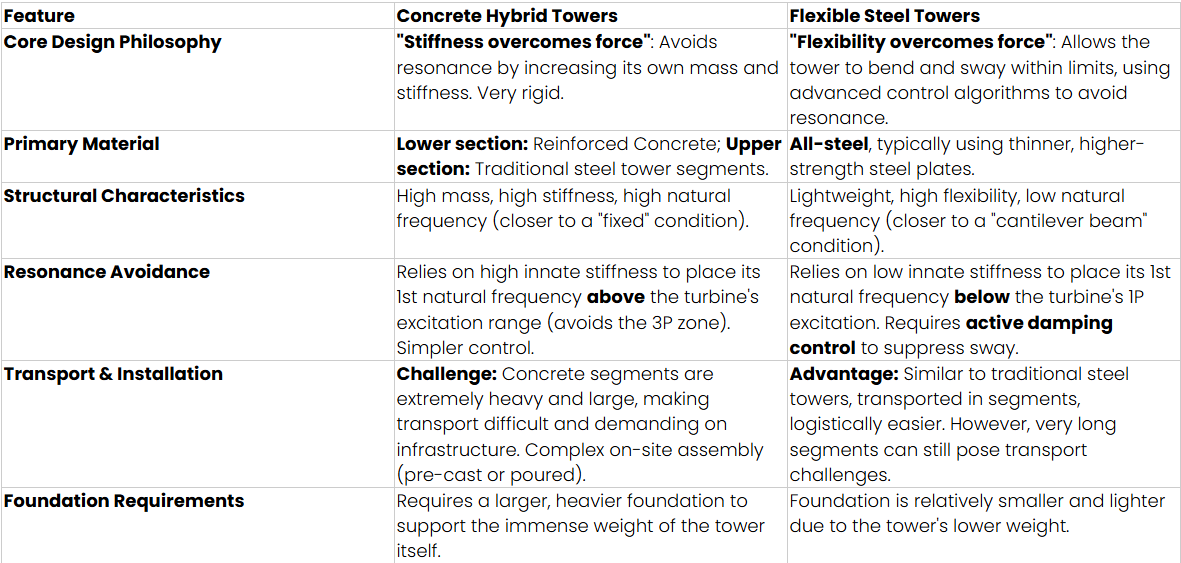
Core Concepts at a Glance
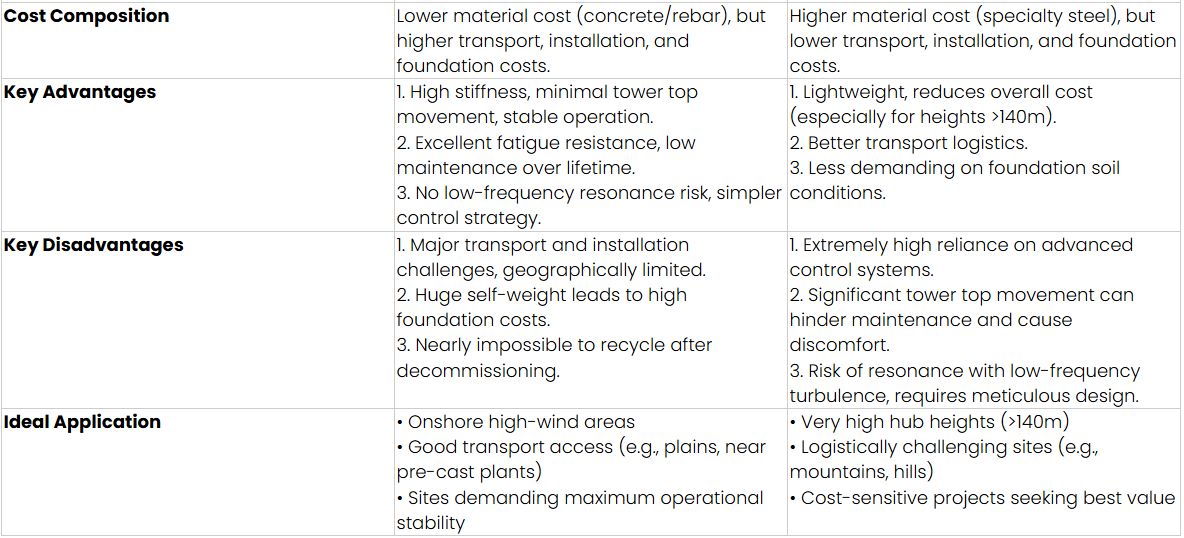
In-Depth Analysis
1. Concrete Hybrid Towers (Hybrid Towers)
A hybrid tower is a combined structure of "reinforced concrete + steel." Typically, the lower ~2/3 is made of reinforced concrete (using pre-cast segments or slip-forming techniques), while the top section is a traditional steel tower connecting to the nacelle.
How it solves resonance:
A turbine's rotation creates two main excitation frequencies: 1P (rotor speed) and 3P (3x rotor speed, from effects like tower shadow). The hybrid tower's massive mass and stiffness place its 1st natural frequency above the 3P frequency during normal operation (i.e., in the "stiff/stiff-stiff" region). This ensures the turbine's operational range does not excite the tower's fundamental resonance, requiring less complex compensation from the control system.
Logic behind pros/cons:
Pro: Stability: Its "stiffness" means minimal sway in the wind, leading to stable operation, reduced mechanical wear, and little need for maintenance over its design life.
Con: Weight: Transporting concrete segments requires special vehicles and places high demands on road and bridge width, weight capacity, and turning radius. This is often unfeasible in mountainous regions. The immense weight also necessitates larger, more massive foundations, increasing civil engineering costs and time.
2. Flexible Steel Towers (Flex Towers / Soft Towers)
Flex towers are all-steel but are designed with an opposite philosophy to traditional rigid steel towers. They are intentionally made flexible using lighter and thinner wall materials.
How it solves resonance:
A flex tower's 1st natural frequency is designed to be below the turbine's 1P frequency (i.e., in the "soft/soft-soft" region). This means the turbine's rotor speed must pass through this resonance point during start-up and shutdown. To manage this, it heavily relies on an advanced turbine control system. The controller must quickly accelerate through the resonance speed and employ active damping algorithms during normal operation. These algorithms constantly adjust generator torque and blade pitch to actively counter the tower's fore-aft motion and prevent the amplification of vibrations.
Logic behind pros/cons:
Pro: Lightweight: Lightweight means material savings, offering significant cost advantages, especially for very high towers. Segmented transport is also more flexible.
Con: Control Dependency: Its safety is based on the precision and reliability of the control system. Poor algorithms or sensor failure could lead to uncontrolled resonance. Furthermore, the tower top can sway over a meter in high winds, which can prevent maintenance access during certain weather conditions and may cause discomfort for personnel in the nacelle.
Summary and Selection
The choice between a hybrid and a flexible tower is a complex techno-economic decision based on specific project conditions:
Choose a Hybrid Tower when: Located in flat terrain with good transport infrastructure and proximity to concrete plants; where project priorities favor high reliability and are willing to pay higher transport and foundation costs for stable performance.
Choose a Flexible Tower when: Targeting the lowest Levelized Cost of Energy (LCOE), for very high hub heights (>140m), in areas with challenging transport logistics (mountains), or where soil conditions are less ideal (allowing for smaller foundations).
Currently, flexible towers dominate the market for very high towers (>160m) due to their cost and logistics advantages. Hybrid towers remain competitive in specific markets (e.g., plains in Central/Southeast China) and applications. Both technologies are evolving, with hybrid towers developing lighter pre-stressed modular designs and flexible towers employing increasingly sophisticated and reliable control strategies.