
 +86 18068001229






0102030405
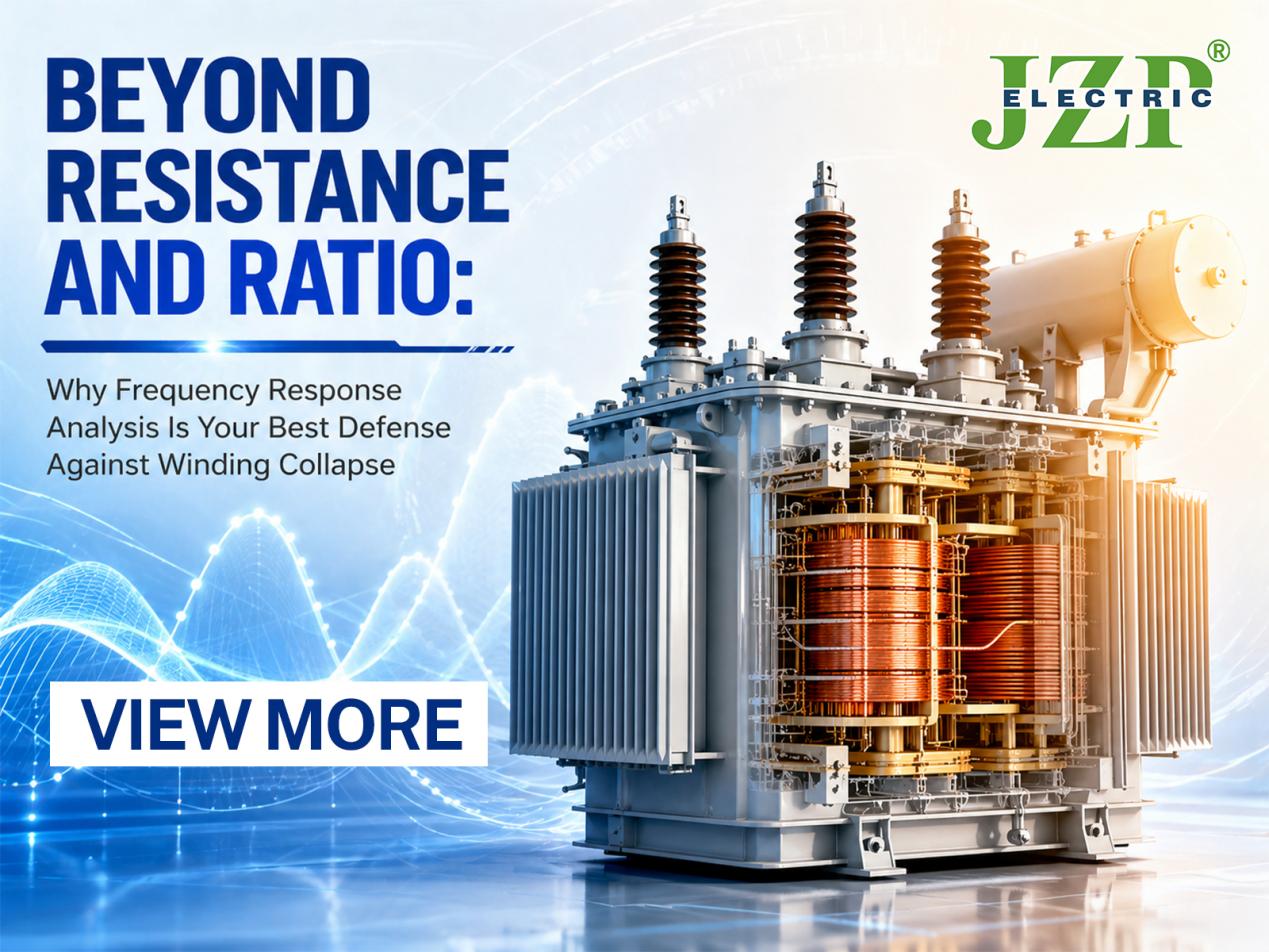
Beyond Resistance and Ratio: Why Frequency Response Analysis Is Your Best Defense Against Winding Collapse
2026-04-30
Introduction
A transformer can pass all standard electrical tests—insulation resistance, turns ratio, winding resistance—and still harbor a potentially catastrophic defect. Winding deformation, caused by short-circuit forces, transportation shocks, or improper handling, often leaves no electrical signature. Yet undetected, it progressively weakens the winding until a single fault current triggers collapse.
Frequency Response Analysis (FRA) is the only diagnostic tool that reliably reveals such hidden mechanical damage. It works by capturing a frequency response “fingerprint” of the transformer’s internal geometry—then detecting the slightest change when that geometry shifts.
Part One: How FRA Works—Capturing the Fingerprint
FRA measures the transformer’s complex impedance over a broad frequency range, typically from 20 Hz to 2 MHz. The technique most widely used is Sweep Frequency Response Analysis (SFRA), which injects a sinusoidal signal at discrete frequencies across the spectrum. The resulting transfer function—the ratio of output to input—reflects the capacitive and inductive network formed by the transformer’s windings, core, and connecting leads.
Because this network is geometrically defined, any mechanical change alters the frequency response curve. FRA is so sensitive that it can detect even sub-millimeter winding displacements that conventional tests miss entirely. The response curve serves as a “mechanical fingerprint”—unique to each transformer and reproducible under identical test conditions.
To be useful, FRA is inherently comparative. A baseline measurement is established when the transformer is new—typically at the factory. Subsequent measurements are superimposed against this baseline. Any deviation indicates a change in mechanical condition.
Part Two: Interpreting the Fingerprint—What Deformation Looks Like
FRA interpretation becomes systematic when the frequency spectrum is divided into functional regions with overlapping perspectives.
Low-Frequency Region (20 Hz – 2 kHz). This region is dominated by core magnetic properties. Changes here—such as magnitude spikes or resonance shifts—suggest core movement, residual magnetism variation, or shorted turns. Tap-changer position also influences this band, so consistent tap settings are critical for valid comparison.
Mid-Frequency Region (2 kHz – 200 kHz). This broad band reflects winding inductance and capacitance interactions. Shifts or resonance peaks here are the clearest indicators of winding movement, disc spacing change, or buckling. Studies confirm that the mid-frequency region (2 kHz–20 kHz) is the most sensitive single band for detecting winding deformation-, while the 20 kHz–400 kHz band can further isolate problems within main or tap windings. In field cases, FRA deviation in this region precisely identified winding buckling that winding resistance tests missed entirely.
High-Frequency Region (>200 kHz). This region is sensitive to lead configuration, termination conditions, and localized winding defects. Changes here may indicate movement of main or tap winding leads.
To reduce subjective judgment, reliable interpretation often combines visual pattern matching with numerical indices such as the correlation coefficient, which quantifies deviation severity. Deviations are generally classified as small (requires monitoring), large (requires investigation), or none.
Part Three: Common Pitfalls—What Can Go Wrong
FRA is extremely sensitive—a strength and a potential weakness. Inconsistent test setup can introduce variations that mask changes or create false positives, which is why standardized procedures are essential.
Four common mistakes undermine FRA reliability:
Poor grounding introduces additional impedances that distort traces, particularly at low frequencies.
Poor test lead connections at bushing terminals alter measurement circuit impedance, affecting a wide range of frequencies.
Inconsistent tap changer positioning changes winding interaction with the internal RLC network—and affects measurements on all windings.
Inconsistent stabilizing tertiary configuration (grounded, floating, open, or shorted) also changes the transformer’s electrical response.
Beyond setup issues, environmental factors like electromagnetic interference, temperature variation, and lead routing all influence measurement repeatability. The solution is rigorous procedure: identical lead lengths, single-point grounding, recorded tap positions, and temperature documentation. International standards such as IEEE C57.149 and IEC 60076-18 provide comprehensive guidance on instrumentation, testing procedures, and data storage.
Part Four: When to FRA—Practical Applications
SFRA is most valuable after events that could cause mechanical damage:
- After a significant through-fault or short-circuit event (applies to all windings)
- After transportation or relocation (shipment is a leading cause of hidden winding damage)
- After factory short-circuit testing (verify no residual deformation)
- After changes in other electrical tests (e.g., winding resistance shifts)
- As part of routine condition assessment for critical assets
In one documented 150 MVA transformer case, FRA revealed significant deviation above 100 kHz despite all standard tests passing. Internal inspection confirmed loose clamping and minor winding displacement from transit. Early detection allowed corrective tightening before energization, preventing a costly in-service failure. In another case, after a network fault, DGA showed low-level arcing, but FRA pinpointed localized winding buckling in the mid-frequency region—enabling timely repair and avoiding catastrophic explosion.
As a proactive measure, many asset owners now integrate SFRA into full lifecycle transformer management. Regular comparative testing shifts maintenance from reactive repair to condition-based prevention, extending asset life and reducing failure risk.
Conclusion
Frequency Response Analysis does not measure what a transformer does electrically. It measures what a transformer is mechanically. The frequency response fingerprint captures the geometric uniqueness of its windings and core. Any change to that geometry—whether from short-circuit forces, transportation shock, or clamping loss—leaves a detectable signature.
For procurement professionals, understanding FRA means specifying baseline measurements at factory acceptance and requiring repeat comparative testing after any condition that risks mechanical integrity. The fingerprint does not lie—and when tracked over time, it provides the most reliable early warning of future failure.