
 +86 18068001229









0102030405
Don’t Trust a Single Number: How to Really Know If Your Transformer Insulation Is Safe
2026-04-30
Introduction
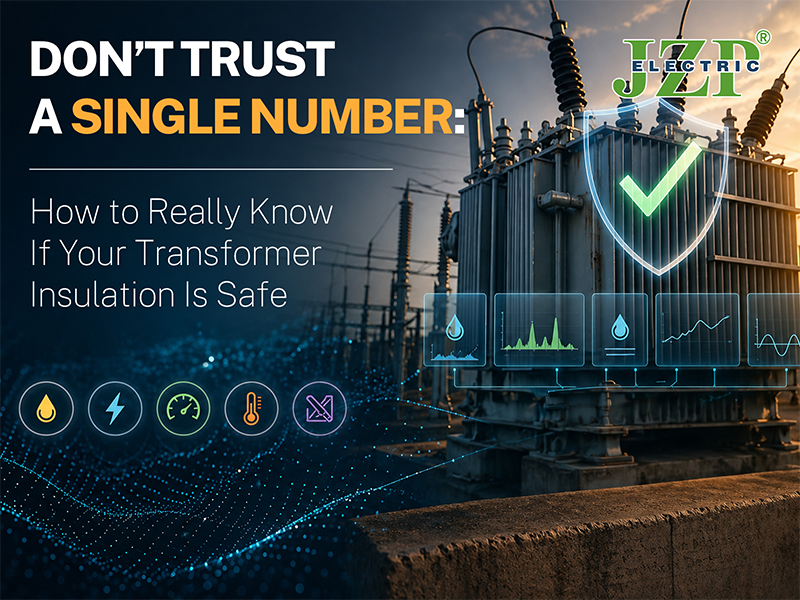
Insulation resistance testing is one of the oldest and most revealing transformer tests. A megohmmeter applies DC voltage and measures leakage current; high resistance indicates healthy insulation, low resistance signals moisture or contamination. But single values tell only part of the story. Time-based indices—absorption ratio and polarization index—reveal far more. This article covers principles, acceptance criteria, and common pitfalls for procurement professionals and asset managers.
Part One: The Five Currents and Why Test Duration Matters
When DC voltage is applied, total current consists of: capacitance charging current (fast decay), dielectric absorption current (slow decay), leakage (steady), surface leakage, and stray interference. The first two cause the total current to drop over time. By measuring resistance at 15 seconds, 60 seconds, and 10 minutes, we separate transient currents from true leakage—the basis of absorption ratio (DAR, R₆₀/R₁₅) and polarization index (PI, R₆₀₀/R₆₀).
Part Two: Required Measurements and Acceptance Criteria
For a two-winding transformer, three core measurements are needed: HV to ground, LV to ground, and HV to LV.
Spot reading (60 s). Rule of thumb: minimum 1 MΩ per 1,000 V of test voltage plus 1 MΩ. Modern dry insulation often measures in gigaohms, where trending against baseline is more meaningful.
Absorption ratio. DAR ≥1.3 indicates good insulation. Required for transformers ≥35 kV, ≥4,000 kVA.
Polarization index. PI ≥2.0 good; <1.5 investigate; <1.0 unacceptable. Required for transformers ≥220 kV, ≥120 MVA. If 60 s reading exceeds 3,000 MΩ, DAR waived; if >10,000 MΩ, PI waived.
Commissioning criteria. Insulation resistance (after temperature correction) not below 70% of factory value. Routine tests: not below 70% of previous value.
Part Three: Key Influencing Factors
Temperature. For every 8–10°C rise, resistance halves. Correct to a common reference (20°C or 40°C) using R₄₀ = R_meas × 2^((40-T)/10). Test only when top-oil temperature is below 50°C.
Humidity. Condensation on bushings causes surface leakage, drastically lowering readings. Test below 80% humidity (preferably <65%). Clean and dry all surfaces.
Residual charge. Always discharge windings for at least twice the previous energization time before testing.
Test voltage. Follow IEEE 43-2013: 2.5–5 kV systems use 2,500–5,000 V; >12 kV use 10,000 V.
Part Four: Procurement and Asset Management Implications
For new transformers. Require factory test reports with DAR, PI, temperature, and humidity. Specify IEEE 43-2013 procedures. Obtain baseline values.
For field acceptance. Verify corrected 1-minute readings are at least 70% of factory values for all three measurement configurations.
For ongoing maintenance. Establish a testing protocol. Record temperature and humidity each time, correct to a common reference. Annual testing recommended for critical assets.
Conclusion
Insulation resistance testing is simple but nuanced. Correct interpretation requires understanding the five currents, using time-based indices, and accounting for temperature, humidity, and residual charge. For procurement professionals, this knowledge turns test reports into actionable intelligence—detecting moisture ingress after transport or justifying a life extension program when PI values trend downward.