
 +86 18068001229





0102030405
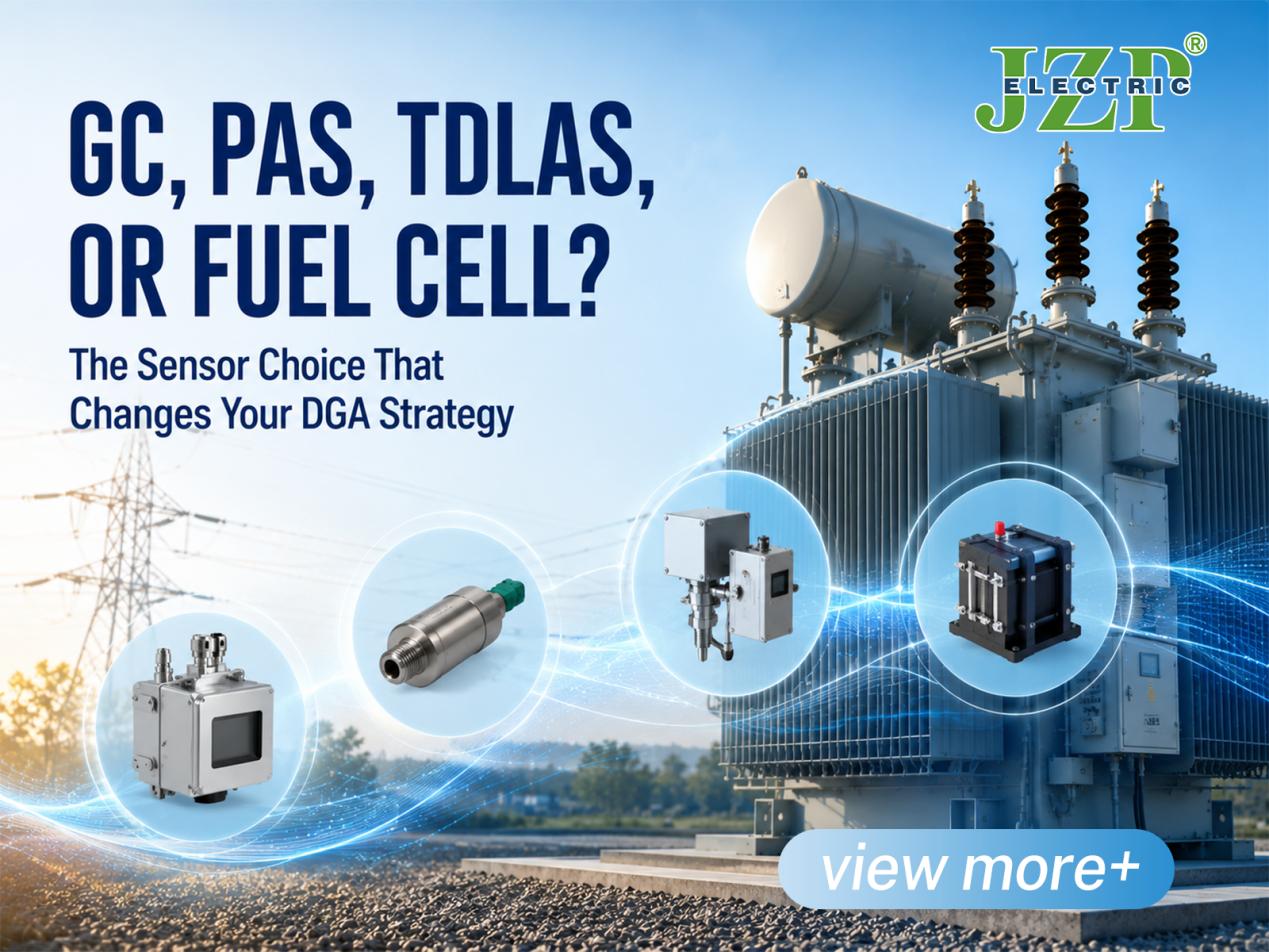
GC, PAS, TDLAS, or Fuel Cell? The Sensor Choice That Changes Your DGA Strategy
2026-05-09
Introduction
Online DGA closes the gap between lab samples and continuous monitoring. Different sensor technologies determine what gases are detected, how accurately, and at what cost. This article compares the leading options: gas chromatography (GC), photoacoustic spectroscopy (PAS), tunable diode laser absorption spectroscopy (TDLAS), fuel cells, and emerging solidstate sensors.
Part One: Gas Chromatography (GC)
GC is the laboratory reference, providing fullspectrum analysis of all key fault gases (H₂, C₂H₂, C₂H₄, etc.) with highest accuracy. Online GC automates sampling and detection, but requires carrier gas, separation columns, and periodic consumable replacement. Mechanical complexity increases maintenance. Best suited for large Power Transformers where failure cost justifies higher monitoring complexity.
Part Two: Photoacoustic Spectroscopy (PAS)
PAS uses a pulsed laser to excite gas molecules; the resulting acoustic wave is detected by a microphone. No consumables, no moving parts. Sequential measurement of multiple gases with high accuracy. Comparative studies show “remarkable consistency” with GC. Ideal for critical assets needing low maintenance and multigas coverage.
Part Three: Tunable Diode Laser Absorption Spectroscopy (TDLAS)
TDLAS targets a single gas absorption line with extreme selectivity and sensitivity (ppb level). No consumables, no moving parts. Often used for acetylene (C₂H₂) – the key arcing marker. For organizations prioritizing specific fault detection over full analysis, TDLAS is a strong, lowmaintenance choice.
Part Four: Fuel Cell Sensors
Fuel cell sensors are the most widely deployed online DGA technology. A gaspermeable membrane contacts oil; dissolved gases diffuse to an electrochemical cell, generating a current proportional to concentration. Output is a composite “hydrogen equivalent” value (sensitive to H₂, CO, C₂H₂). Compact, no pumps, no consumables, no moving parts. Cannot identify individual gases or fault types, but provides reliable earlywarning trends. Best for large Distribution Transformer fleets.
Part Five: Solid-State and MEMS Sensors
Solidstate (MOS) and MEMS sensors change resistance when exposed to specific gases. Compact, low power, potentially low cost. However, performance in real transformer oil has been less consistent due to crossinterference. Technology advancing rapidly; MEMSbased H₂ and C₂H₂ monitors are appearing commercially. Worth monitoring for future deployment.
Conclusion
No single online DGA sensor fits all applications. GC delivers full precision at higher maintenance cost; PAS offers multigas coverage with very low upkeep; TDLAS provides targeted, highsensitivity singlegas detection; fuel cells give lowcost early warning for fleet screening. Match sensor capability to transformer criticality, gas coverage needs, and maintenance budget. For procurement, always request thirdparty validation of detection limits in real transformer oil, and consider a twotier strategy: online sensors for continuous trend watching plus periodic lab GC for confirmation.