
 +86 18068001229






0102030405
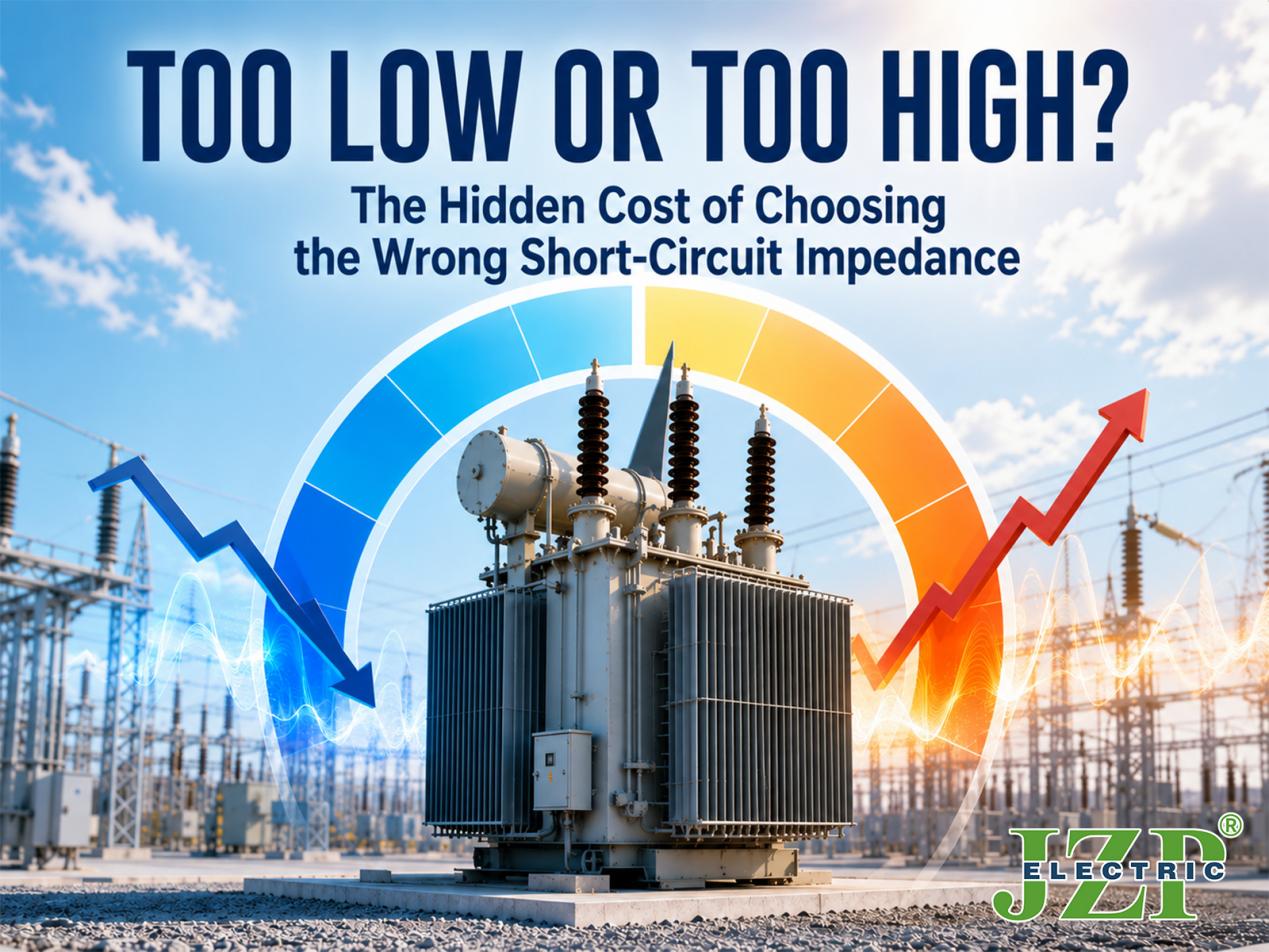
Too Low or Too High? The Hidden Cost of Choosing the Wrong Short-Circuit Impedance
2026-05-08
Introduction
Short-circuit impedance (Z%) is a key parameter on every transformer nameplate, yet it is often overlooked during procurement. It affects fault current levels, voltage regulation, parallel operation, and cost. Choosing too low a value exposes downstream equipment to excessive fault stresses. Choosing too high a value degrades voltage regulation and increases losses. This article explains the trade-offs and guides procurement professionals to the right choice for their application.
Part One: What Short-Circuit Impedance Means
Short-circuit impedance is the percentage of rated voltage required to drive rated current through one winding while the other is shorted. A 10% impedance means that applying 10% of rated voltage produces full rated current under short-circuit conditions. Under a direct fault, the current will be approximately 1/Z% times rated current (e.g., 10 kA for a 10% transformer with 1 kA rated current).
Higher impedance limits fault current—reducing mechanical stress on windings and interrupting duty on breakers. Lower impedance improves voltage regulation (smaller voltage drop from no-load to full load) and reduces reactive power consumption, but increases fault current levels throughout the system.
Part Two: The Key Trade-Offs
Fault current limitation. Transformers with low impedance (e.g., 4–6%) can produce fault currents that exceed the interrupting capacity of standard switchgear, requiring expensive upgrades. High impedance (e.g., 10–15%) lowers fault currents, allowing smaller, less costly switchgear. However, every 1% increase in impedance raises no-load losses by approximately 2–3% and adds 1–2% to manufacturing cost due to additional windings or larger core.
Voltage regulation. For distribution feeders, a low-impedance transformer maintains tighter voltage at the far end under heavy load. High impedance causes larger voltage drops—acceptable only where load variations are modest or downstream regulation exists.
Parallel operation. Transformers operating in parallel must have closely matched impedance (typically within ±7.5% of each other) to share load proportionally. Mismatched impedance causes one transformer to overload while the other remains underloaded, reducing reliability.
Short-circuit withstand. While lower impedance devices are generally more susceptible to mechanical damage during external faults, actual withstand capability depends on winding design. Impedance alone does not guarantee ruggedness; designers address this through reinforced clamping and conductor material selection.
Part Three: Selecting the Right Value
Industry practice provides typical ranges:
- Distribution Transformers (≤ 2.5 MVA):4–6% – balances fault current and regulation for most utility and commercial applications.
- Power Transformers (> 10 MVA):8–15% – higher impedance limits fault duty on transmission breakers and reduces through-fault forces.
- Industrial applications with large motors:6–8% – moderate impedance limits voltage drop during motor starting while keeping fault currents manageable.
- Generators or weak grids:10–12% or higher – protects generators from damaging fault contributions.
For parallel operation, always verify that the new transformer’s impedance matches existing units within tolerance. If not, forced load sharing increases losses and shortens life.
High-impedance transformers also consume more reactive power (approximately 1% of rated kVA for each 1% impedance), which may require additional capacitor banks for power factor correction—an often-overlooked operating cost.
Conclusion
Short-circuit impedance is not a value to accept passively from a standard design. It should be selected deliberately, balancing fault current limitation, voltage regulation, parallel operation, cost, and losses. For buyers, specifying the correct Z% prevents both over-stressed switchgear and under-performing feeders. Discuss the intended system fault level and load profile with the manufacturer, then select the impedance that minimizes total ownership cost—not just first cost.