
 +86 18068001229





0102030405
What Is The Difference between Pole Mounted And Pad-mounted Transformers?
2025-10-23
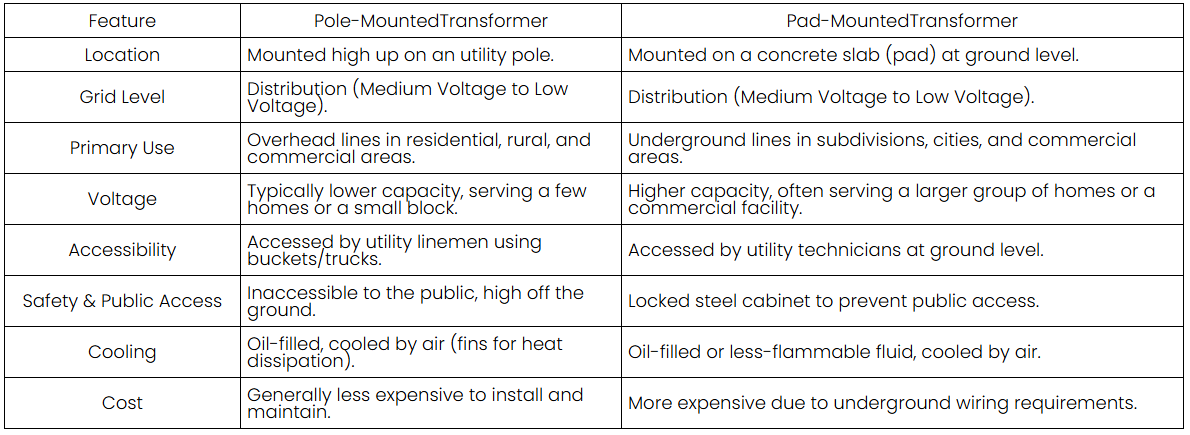
At a Glance: Key Differences
Detailed Explanation
Pole-Mounted Transformers
These are the cylindrical tanks you see attached to wooden utility poles, often accompanied by fuse cutouts and other hardware.
- Construction & Installation:They are bolted directly to the pole between the primary (high voltage) and secondary (low voltage) power lines. The high-voltage wires enter throughbushings on the top, and the low-voltage wires exit through a weatherhead on the side, running along to the service drop that connects to a house.
- Application:They are the standard for overhead Power Distribution You'll find them in:
1.Older neighborhoods
2.Rural areas
3.Along highways
4.Anywhere where power lines are run above ground.
- Advantages:
Lower Cost: Cheaper to install and maintain as they don't require digging trenches for lines.
Easier Access for Repair: Linemen can quickly access them with bucket trucks.
Easier Fault Location: Problems are often visible from the ground.
- Disadvantages:
Exposure to Elements: Vulnerable to damage from storms, high winds, falling trees, and vehicle collisions with poles.
Aesthetics: Considered by many to be visually unappealing.
Safety Risk: While high up, an accident or severe storm can bring them down, creating a hazard.
Pad-Mounted Transformers
These are green, metal, locked cabinets sitting on a concrete pad at ground level, often in a backyard easement, a parking lot, or on the side of a commercial building.
- Construction & Installation: They are heavy, steel, tamper-proof enclosures designed to protect the public. All high-voltage and low-voltage cables enter and exit underground. They are filled with oil or a safer, less-flammable dielectric fluid.
Application: They are exclusively used with underground electrical distribution systems. You'll find them in:
1.Modern residential subdivisions
2.Urban city centers
3.Commercial parks
4.Hospitals and schools
5.Any area where lines are buried for aesthetics or reliability.
- Advantages:
Improved Reliability: Protected from wind, ice, and falling trees, leading to fewer weather-related outages.
Aesthetics: Much less obtrusive than overhead lines and poles, maintaining the visual appeal of a neighborhood.
Public Safety: The locked, grounded steel cabinet makes them very safe from accidental public contact.
- Disadvantages:
Higher Cost: Significantly more expensive due to the cost of trenching, conduit, and the transformer itself.
Slower Repair: Locating and repairing faults in underground lines can be more time-consuming and destructive (requires digging).
Vulnerability to Flooding: Must be installed in areas not prone to flooding, or be specially designed for it.
Summary: The Core Difference
The choice between pole-mounted and pad-mounted transformers isn't about one being "better" than the other in a vacuum. It's about the design of the electrical system:
Pole-mounted transformers are for overhead lines.
Pad-mounted transformers are for underground lines.
This fundamental difference in application dictates their design, location, cost, and the advantages/disadvantages they each bring to the power grid.